Last week, I walked into my presentation with a bandage on my forehead. Before I started, I told the students what happened: I had tripped, hit my forehead, and ended up with a small cut.
Why did I start there? Because otherwise it would have been the elephant in the room and kids always notice ‘the elephant’. If we don’t explain, they fill in the gaps with their own guesses, worries, or assumptions.
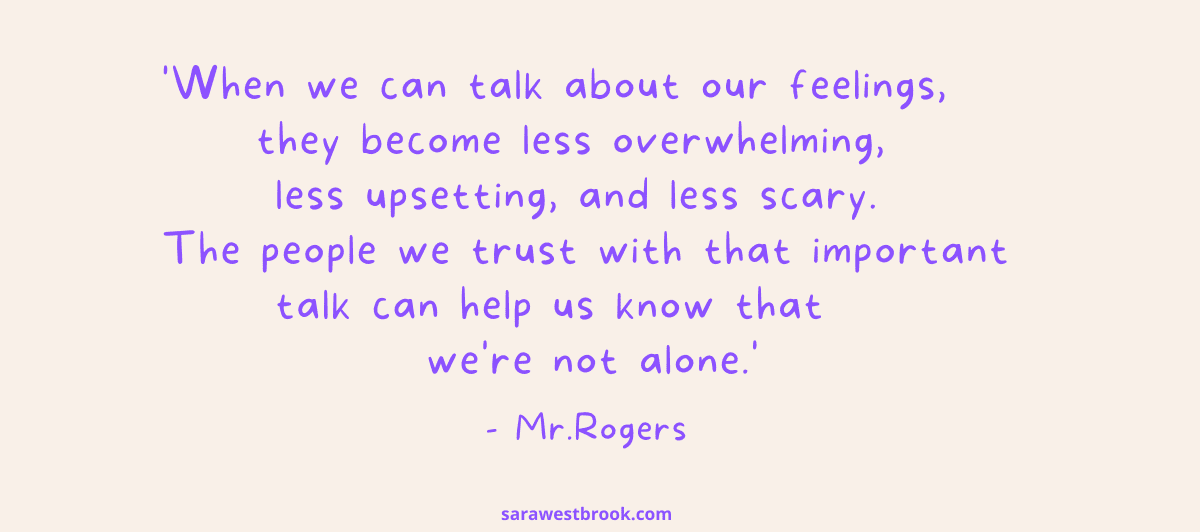
Sharing what’s happening shows kids that it’s okay to notice, ask questions and share how they feel – the keys to building connection with kids in everyday interactions.
Ways to Connect 1. Name it: Tell them what’s happening when they notice something. 2. Keep it simple: A short, honest explanation is enough. 3. Invite conversation: Encourage questions and let them share their feelings.
When you do this, you are showing children that they can trust their observations and their feelings.
This is what I know: They will learn they are not alone, that feelings matter, and that mistakes are part of life – all essential for building connection with kids and helping them grow into compassionate, confident, and resilient people.
Until next time…
5 Apr 2023
Two Strategies to Help Kids with Their Challenging Behaviours
When kids display challenging behaviours, it’s easy to react from your emotions.
You can easily respond with frustration, irritation and anger, triggering you to yell, ‘Why would you say/do that?!’
Training yourself to be aware of the emotions you are experiencing and how to navigate them is an essential part of teaching kids to do the same.
Before you can help a child self-regulate – you must do it first.
Take a moment to pause and breathe deep. Then try asking this question, ‘What were you feeling when you said/did that?’ You are now creating an opportunity for a more meaningful and empathetic dialogue which will help you get to the root of what is really happening.
Helping children learn to be aware of their emotions and how to move with and through them in healthy ways helps to shift their behaviour.
Here are two strategies I find extremely helpful to do with my 10 year old son…
If he can’t find the words to tell me the emotion he is feeling, I bring out the ‘elephant emotions‘ poster. Approaching the situation from this angle allows him to identify the emotion that led to his behaviour. It also helps him understand that he was making his choice from that emotion. I remind him that he is a good kid that is having a hard time with his emotions.
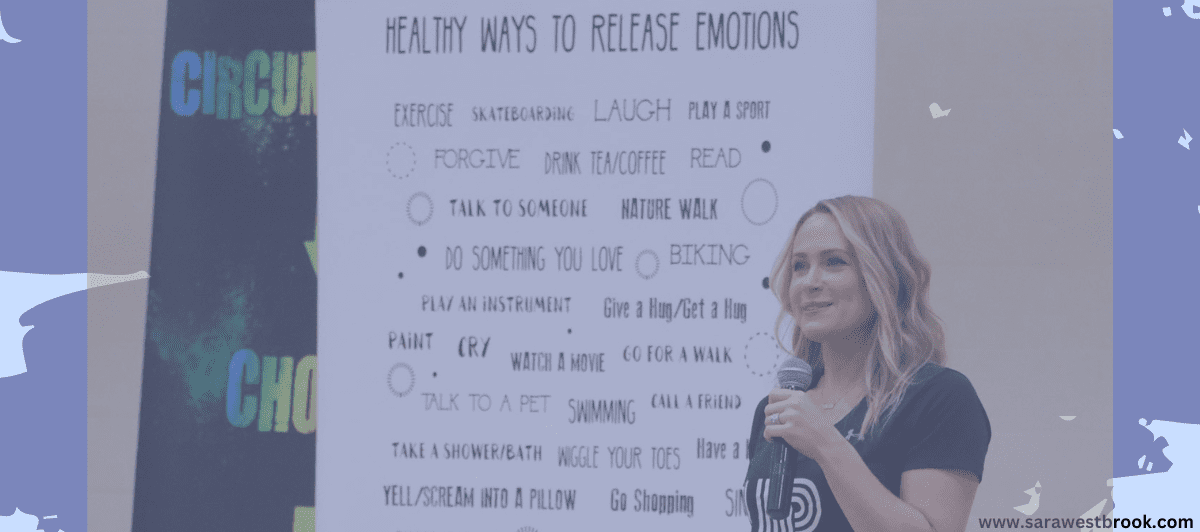
Then we talk about ways he can work through that emotion – deep breathing, jumping up and down, squeezing his hands together, talking to someone etc.
This is what I know: When a circumstance happens, it triggers an emotion and out of the emotion you see a behaviour. These two strategies will help you discuss openly the process of recognizing, identifying and releasing emotions in healthy ways so that the next time they react from a circumstance, instead of reprimanding, you can say with compassion and patience, ‘What are you/were you feeling?’
Until next time,
22 Mar 2023
Words You Don’t Want to Hear
Have you ever heard your child say these hurtful words, “I hate you. I don’t like you. You’re the worst.”
Hearing those words can trigger emotions of sadness, anger, even confusion and embarrassment. In these emotional moments, it’s easy to become reactive.
‘You’re being rude and disrespectful’ may be your response or you may find yourself saying, ‘Don’t talk like that. You’re making me sad.’
You can easily take offense to these hurtful words, knowing how much you do for them. However, because children have strong emotions, they can explode without a moment’s notice, especially when they aren’t getting their own way.
I can remember times as a preteen and teen when I would tell my mum I didn’t like her. My mum would respond in a calm voice with a simple ‘okay’. Kids need to know that the feelings that overwhelm them do not overwhelm us.
Now, when my son says the same thing to me, I remember not to take those emotionally charged words personally. I know he is really saying, ‘I don’t like your rule, boundary, consequence or decision you made.’
TRY THIS: Respond with ‘I can tell you are upset.’ Honour the emotions they are experiencing beyond the words they are saying.
Until next time…
9 Nov 2022
Kids want you to know…
‘I really enjoyed your presentation. It opened a few doors for me. This past year I went through some problems but your presentation showed me another way of looking at my problems. You really helped me to know that my feelings big or small are normal and that it’s okay to feel.’ – Male Student
Sometimes kids think they should only feel HAPPY because they believe that is the only way people will accept them.
Kids tell me that when they hear, ‘It’s OK to feel what you are feeling’, they know they have been respected and validated – that they have been given the space to express and share their emotions.
Space to feel gives space to heal.
Practicing ‘space’ builds connection (1 min video). It allows kids to feel comforted, supported, and more open to finding ways to move with and through their emotions.
Remind them that feeling a wide range of emotions is natural and normal and that we accept them no matter how they are feeling.
The more we choose to step outside our comfort zone by acknowledging and sharing our own emotions, we model and teach them that…‘It’s OK to feel what you are feeling‘.
Until next time…
12 Oct 2022
How to Help a Child’s Negative Self-Talk
Kids are constantly encountering new experiences and challenges which can trigger uncomfortable emotions causing them to speak negatively about themselves. No one wants to hear a child putting themselves down.
Positive self-talk is about speaking to themselves with compassion, empathy, kindness and respect.
Benefits of Positive Self-Talk
Builds self-esteem
Enhances emotional & mental well-being
Improves self-regulation
Boosts confidence in their own abilities
Influences their choices & decisions
Develops resilience
Tips to Promote Positive Self-Talk
Emotions – Kids want to know that they are not bad, nor wrong for feeling how they feel. We all feel a wide range of emotions. They can feel angry, frustrated, disappointed and still show respect for themselves, others and their dreams. Kids need to be reminded, ‘It’s ok to feel.’ These words provide both comfort, validation and connection.
Reframing – Redirect their thoughts by asking them questions like: ‘What is one lesson you learned from this experience?’ or ‘Who could you ask to help support you?’ or ‘ What could you do differently the next time?’ Helping them see the circumstance through a different lens helps them to learn and grow.
Model positive self-talk – Modelling what you want children to learn is the best way to teach. If you find you are putting yourself down, admit it. Use it as a teachable moment. Let’s face it – we’re not perfect! Let them know what you wish you would have said.
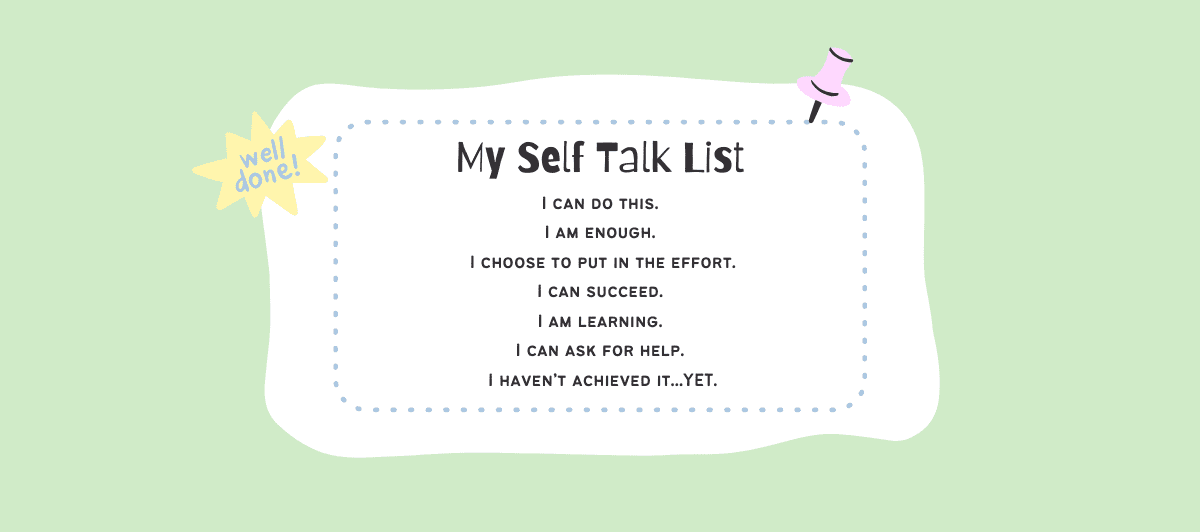
Recognize their talents & strengths – Even though it’s important for them to recognize negative thoughts and uncomfortable feelings, they can learn to reframe their mindset and focus on their strengths. Have them create a list of their talents & strengths to have a visual reminder.
Gratitude – Choosing to focus on something they are grateful for is a powerful mindset shift that helps them bounce back from challenging times and move though tough emotions. Since their brain can only focus on one thought at a time, choosing to look at what they are grateful for (especially during difficult times and mistakes made) is a powerful practice that strengthens resilience. Ask them, ‘What could you be grateful for from the challenge or mistake?‘
Over time what children repeat determines their belief about themselves and their abilities. Below is a list of phrases your child/student can use to remind them that what they say matters to their confidence, resilience & well-being.
Until next time…
28 Sep 2022
It Hurts to be Bullied
Being bullied happens too often, and it can make kids feel scared, sick, embarrassed, anxious, depressed and sad. Bullying can make them feel alone with nowhere and no one to turn to.
That’s why Paul Davis (internet safety expert) & I decided to invite Emily, who is 18 years old, to join our podcast to share her bullying story that began in grade 3.
Words from Emily: ‘In grade 3 no one liked me & I don’t know why. No matter how hard I tried I couldn’t fit in. I was the one who got picked last in gym class. I kept saying grade 4 will be better. It did get better for a while until the day our teacher asked us to mark each other’s spelling test. When mine was returned to me I saw messages written on it, “You’re not smart! You’re dumb!”
You feel so hopeless. You believe you will never get out of being bullied. You have no reason to go to school – you hate it there. My principal tried to help and for a while it was fine until it wasn’t. When you’re 9 years old you are just starting to figure out life and when the adults have no hope of fixing the situation you feel alone.’
Paul Davis reminds us that we need kids to know if they speak out about any type of bullying, they will be supported.
Once Emily entered high school, she had an idea…click here to watch or here to listen to the full podcast where Emily shares her idea.
One piece of advice to adults from Emily: ‘The most helpful thing an adult can do for a child that is being bullied is to take the time to listen & to let the child talk about how they are feeling & then help work through their emotions together, so it isn’t just on the child’s shoulders.’
Until next time…
18 Mar 2021
What Kids are Telling Me
As a parent/educator it can be frustrating when your children/students won’t communicate with you. They clam up and it feels like they block you out. Trying to get through seems like a tug of war… and your team is losing!
By acknowledging and validating their emotions, you give them permission to feel what they are feeling. Without acknowledgement and validation, they are more likely to react by shutting you out. When they feel understood they will be more open to communicating and sharing. They will know that you are on their team.
I have asked kids what helps them when they are feeling angry, overwhelmed, anxious, irritated or sad. This is what they said

)